They un-exist.
There are no monsters. No invading armies. The frontier resists permanence in ways the Bureau has not yet been able to classify — not because the observations are insufficient, but because the categories themselves may be inadequate. Structures stand. People work. And still, slowly, everything comes undone.
The measure we designate Horizon tracks how much accumulated reality a settlement has managed to establish. When it reaches zero, the settlement does not fall. It becomes insufficient to have existed. The distinction is not semantic. It has practical consequences the Bureau is still working to classify.
The Horizon does not count down. It accumulates — reality layered on reality, memory compressed into substrate. Feed it what you build. Feed it what you remember. The settlement grows heavier. More real. More present.
When the weight becomes insufficient, the settlement does not fall. It becomes insufficient to have existed. The Bureau has found no better way to describe this. The Bureau is working on it.
governor's archive.
The following records were recovered from the most recent settlement attempt. They are reproduced here in full. The Bureau notes that certain records predate the settlement's founding by years. This discrepancy has been flagged. It has not been resolved.
A story told once at the fire.
A name someone almost forgot.
Not history yet.
Just… something that happened.
We are collecting the pieces.
Two stories find each other.
A name remembered by more than one mouth.
That is enough.
That is all it takes.
The past is no longer just ours to lose.
We are building quickly.
Too quickly.
People sleep less. Tempers rise faster.
The city stands.
Its foundations feel tighter than before.
before. The records
do not say what became of them.
The following is reproduced from the Charter issued to the most recent appointed Governor. The Bureau has reviewed it. The Bureau has no additional comment to offer on its contents. The silence noted by the Governor is a matter of record.
The seal of the Empire is still warm from the press.
We are not the first to be sent beyond the boundary. Others carried this same promise of land, of permanence, of legacy.
The silence they left behind is not mentioned in the decree.
I choose to read that as omission, not warning.
what a settlement looks like.
From the outside.
The following visual records were recovered from monitoring conducted during the most recent settlement attempt. They are reproduced here in the order they were filed. The Bureau notes that some of these images raise questions the Bureau does not currently have forms for.
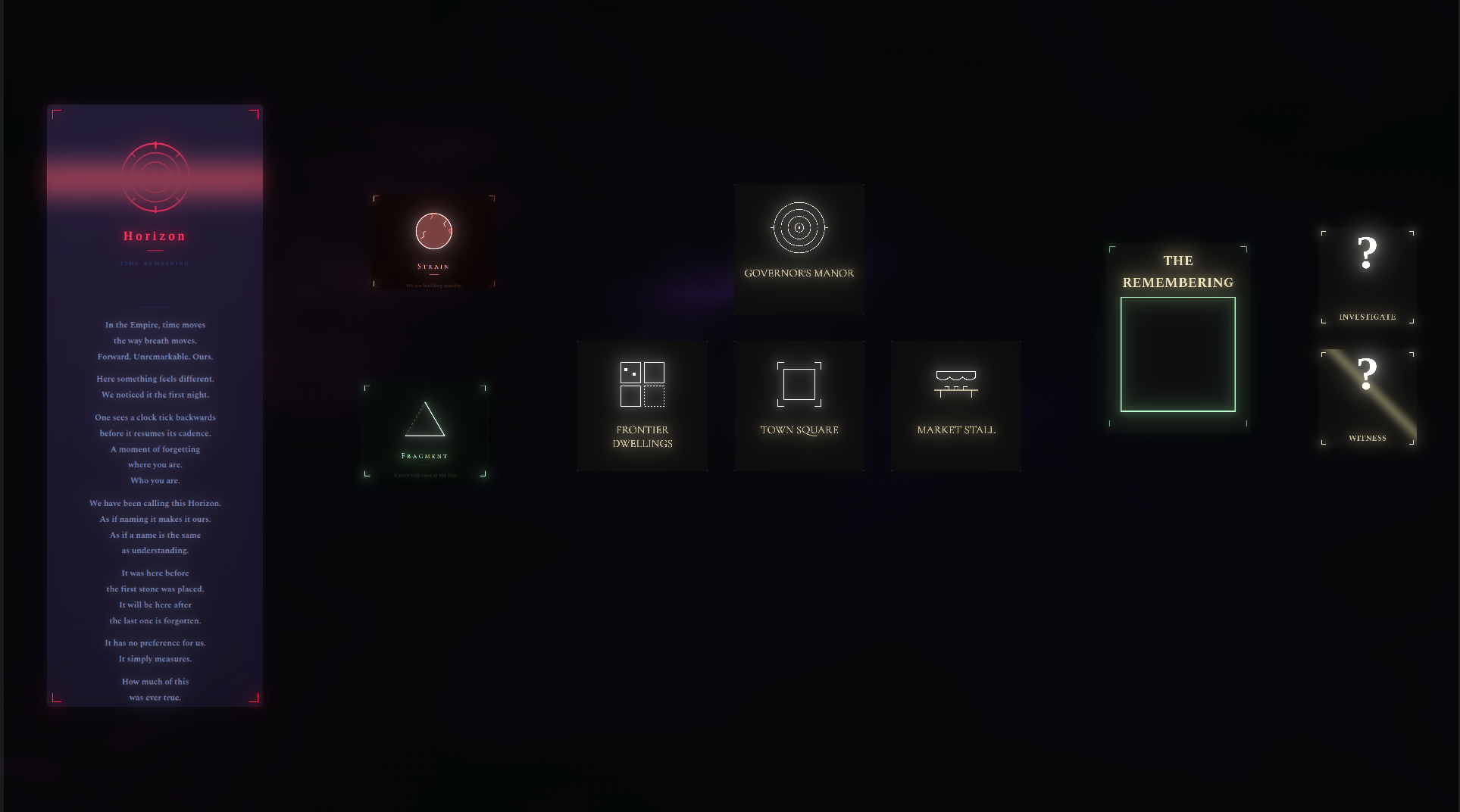
The frontier decides what results.
Each run begins with a charter and a choice of outpost. Cards spread across the board as the settlement grows — resources, buildings, story triggers, and things the frontier sends that were not requested. Combine cards to craft, construct, and generate new possibilities.
The board is never tidy. That is expected. The Bureau has noted that governors who keep tidy boards tend not to last as long as governors who learn to work in the margins.
four arcs. No two
resolve the same way.
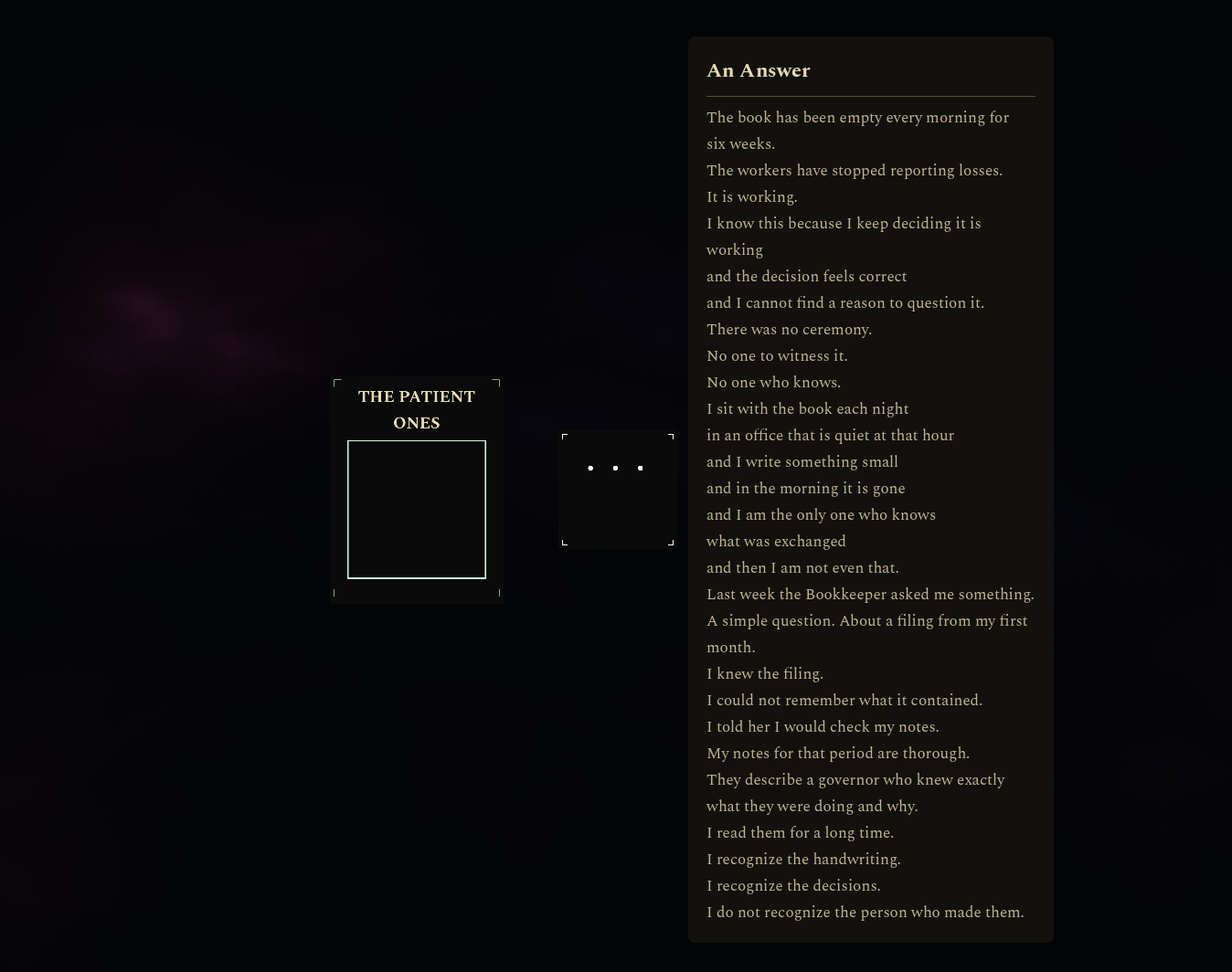
Story Arcs are the core of each run. A story verb card activates, presenting a situation unfolding at the frontier's edge. The governor makes choices. Those choices gate what the second cycle can become.
Each arc leaves something behind — a legacy district, a named token, a change in the obituary. What the next governor inherits is what this one decided.
remains. Differently
than you intended.
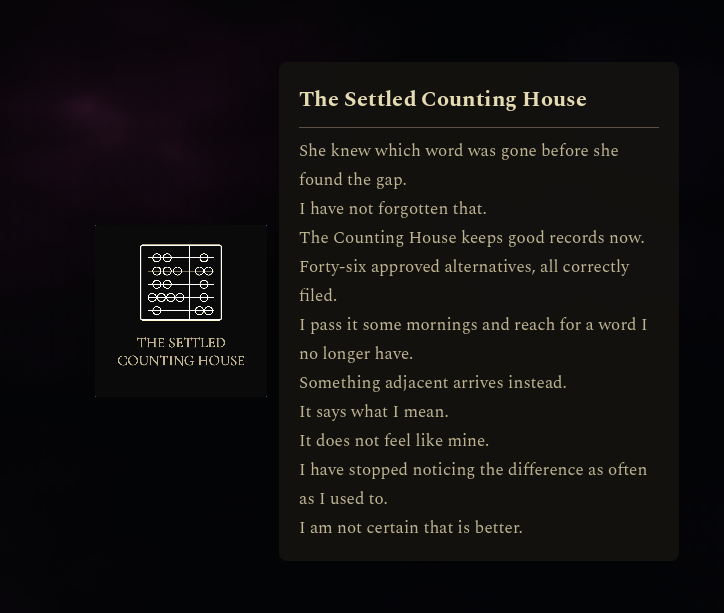
Every arc conclusion produces a legacy district — a card that carries the specific text of what happened in that run. The Counting House knows which word was gone before it found the gap. The governor passed it some mornings and reached for a word they no longer had.
Legacy districts accumulate across runs. The next governor arrives to find a frontier that remembers the last one. Not accurately. Not completely. But persistently.
The paperwork
is just beginning.
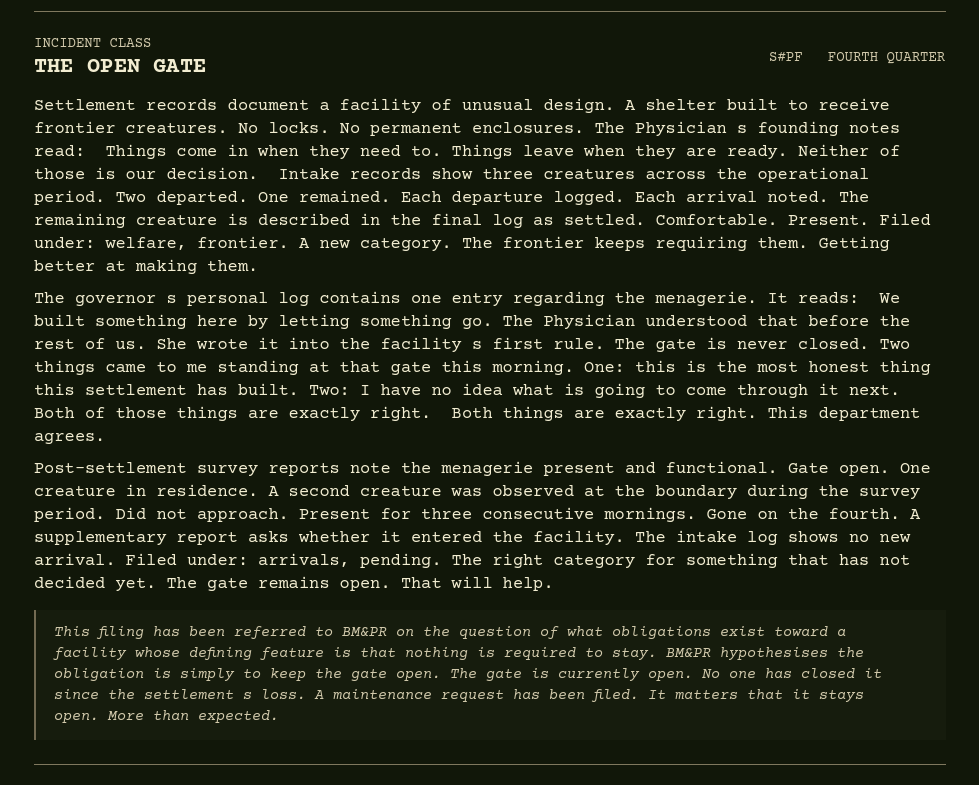
Every run concludes with a disposition filing assembled by the BFSAP from the specific record of what occurred. Which arcs completed. Which branches were chosen. What the governor decided not to investigate. What the frontier decided on its own.
The filing is the point. Not survival. Not a score. A document that describes something that happened, in the voice of an institution that is very good at describing things it does not understand.
What we have learned.
The following findings are drawn from all recorded settlement attempts. Governors are briefed on these findings prior to departure. The Bureau notes that being briefed on them and being prepared for them are not the same thing.
What you see is what is possible.
You can always see what can be combined. You cannot always see what will result. The frontier's randomness lives in outcomes — not in whether your choices can be made.
Every action is a commitment.
Resources are precious. Actions, once committed, cannot be recalled. The frontier does not forgive hesitation, and it does not forgive haste. It simply continues.
Pressure is always visible.
No hidden collapse. No sudden reversals. The frontier is honest about what it is doing. Governors who fail do not fail by surprise. They fail by running out of answers to a question they could always see coming.
The frontier cannot be defeated.
Only delayed. Only understood. Perhaps, in time, reshaped. Collapse is not failure — it is the record. What the next Governor inherits is what the last one learned. Each attempt leaves something behind.
with a document.
The Bureau assembles a final record from each settlement attempt — constructed from the specific constellation of choices made, districts built, arcs resolved, and things left unexamined. No two records are the same. Governors have been known to keep theirs. The Bureau files all of them. They make for difficult reading.
Settlement records document a facility of unusual design. A shelter built to receive frontier creatures. No locks. No permanent enclosures. The Physician's founding notes read: Things come in when they need to. Things leave when they are ready. Neither of those is our decision.
The governor's personal log contains one entry regarding the menagerie. It reads: We built something here by letting something go. The gate is never closed. I have no idea what is going to come through it next. Both of those things are exactly right.
Post-settlement survey reports note the menagerie present and functional. Gate open. One creature in residence. A second was observed at the boundary during the survey period. Did not approach. Present for three consecutive mornings. Gone on the fourth. Filed under: arrivals, pending. The right category for something that has not decided yet.
only file.
The Bureau maintains records beyond this assessment. Two further investigations are active. Access requires separate authorisation. The Bureau notes that the auditor dispatched to verify the most recent settlement's status has filed an inconclusive report. The Bureau has requested a supplementary filing. The Bureau is still waiting.
We Were Here Before
The Governor builds. Manages. Holds on. The frontier dismantles things that cannot be seen. The records in the archive predate the settlement's founding. The Governor has not yet asked why.
The Last Auditor
The settlement is gone. The investigator is still there. They do not know how long. Their investigation will not discover what happened. It will decide it. Retroactively.
In Triplicate
A bureaucrat in the capital. Processing paperwork. Approving settlements, filing reports. No awareness of what any of it actually does. The machinery runs. It has always run.
has your name on it.
The Bureau proposes a further settlement attempt at Frontier District Seven. A Governor has been identified. The Charter is prepared. The seal is warm. This document constitutes the formal record of that proposal and requests countersignature from the relevant Imperial authority.
Previous attempts are a matter of record. The Bureau does not consider them failures. They are, in the strictest sense, preparation.
Note: This charter must be filed in triplicate. One copy for the Imperial Archive. One copy for the Bureau of Frontier Settlement. One copy to be transmitted beyond Horizon.
The third copy's disposition is not the Bureau's concern. The frontier will receive it as it receives everything.